
 Login
LoginOur Online Account & Loan Application System will be down for routine scheduled maintenance Saturday, August 29, 9:00 PM Central Time and is expected to begin its regular operation time by 5:00 AM Sunday, August 30.
We apologize to our customers for the inconvenience of the recent debit card compromise. The issue is currently being resolved. If you have any problems with your card, please contact Account Services at (225) 654-5647.
Our telephone banking line, 225-654-1516, is currently down for maintenance. Due to a hardware issue, it will remain down until the hardware is replaced. The hardware is being shipped overnight to the bank, and will arrive on 12-10-2014. We apologize for any inconvenience this may cause.
We apologize to our customers who are having to replace debit cards compromised in the Home Depot breach. We are in the process of notifying those affected.
As always, please carefully review your bank statements for unauthorized activity, and let us know if you have any questions or concerns.
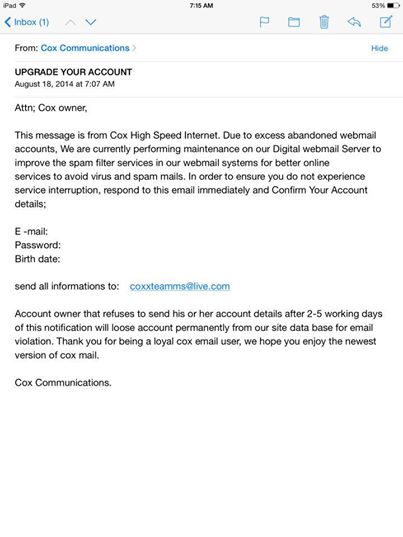
I received the email below this morning, purporting to be from Cox Communications. This IS NOT from Cox. It is a "phishing" email designed to steal personal information. If you receive this email, please report it to Cox. More information is available at cox.com.
- Preston Kennedy, President/CEO
Bank of Zachary
Our Account Services Department received numerous calls the week of July 14 from Bank of Zachary account holders who are receiving fraudulent calls regarding their deposit accounts. These calls ARE NOT originating with the Bank of Zachary and should be treated as an attempt to defraud. At least some of the fraudulent callers identify themselves as "Mid South Bank", "Mid City Bank" or "Mid America Bank".
The call, usually computer generated, instructs the listener to enter a debit card number, then asks for the Personal Identification Number (PIN).
Please DO NOT share information with anyone, especially your PIN. If you receive a call requesting any information, HANG UP! Call us at (225) 654-2701 if you have any questions
Have you heard the exciting news? You may have received a letter or seen a poster “teasing” our new website that is launching soon. A great feature of this new site is that you will be able to do just about everything you can do in our branches – online! Technology is only continuing to advance and the world around us shows no sign of slowing down. Our goal is to accommodate our customers by creating a more accessible website with improved online capabilities.
The new design and action-based navigation will make it easier to learn about Bank of Zachary’s products and services, access powerful and easy to use calculators, ask questions, find educational resources, open accounts, apply for loans, chat with us online, and more! In essence, our website will be a virtual branch that’s open 24/7 – so you can bank the way you want to. Here’s a sneak preview: http://bankofzachary.pwlanding.com/005/
Along with the website, we’re also introducing enhancements to our account choices. We’re simplifying what we offer – making it even easier to bank with us.
We are excited to unveil these changes soon. Stay tuned!
A Baton Rouge area bank is reporting that their official checks (cashier's check) have been counterfeited. An actual bank customer's name was on the counterfeit check. Turns out that the customer had been asked to obtain a cashier's check to make a small purchase. If you are asked to purchase an official check when using cash, a personal check, or a debit card would seem to make more sense, contact your bank immediately. Thanks for your help!
You may receive an “award letter” claiming to be from Microsoft but in fact is just a scam designed to steal your identity.
Do not respond to this email if you receive one – it is a complete scam and I post it below to make you aware only!
For more information visit: http://www.auditmypc.com/microsoft-award-letter.asp
Some postal customers are receiving bogus e-mails about package deliveries or online postage charges. The e-mail contains a link or attachment that, when opened, installs a malicious virus capable of stealing personal information from their PC.
The e-mail claims to be from the U.S. Postal Service and contains fraudulent information about an attempted or intercepted package delivery or online postage charge. The customer is instructed to click on a link, open the attachment, or print the label.